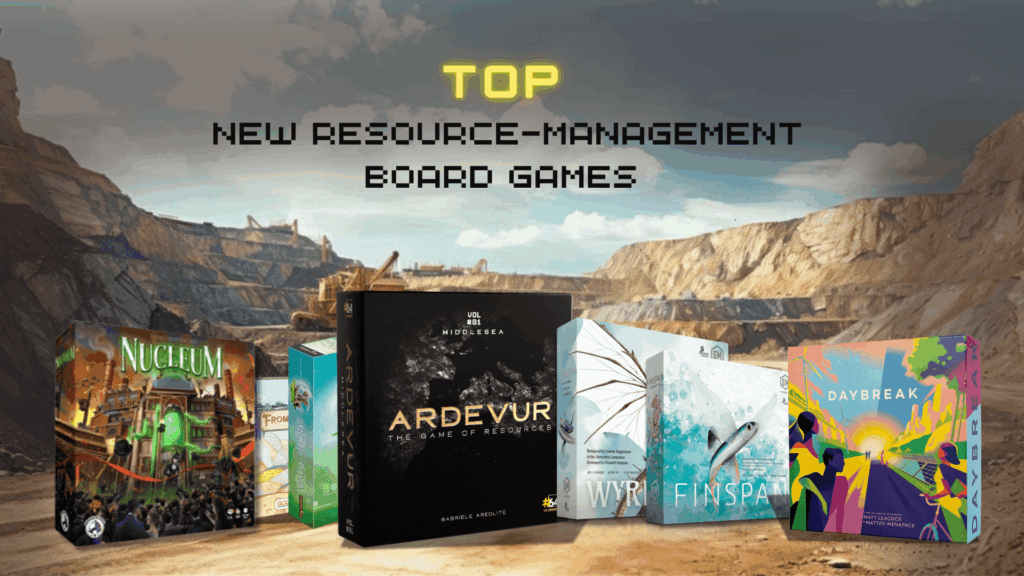

Resource-management games blend economic planning, engine-building, and strategic decision-making into deeply engaging tabletop experiences. This genre continues to evolve, offering players a rich variety of mechanics—from the elegant and efficient to the immersive and thematic. The recent lineup showcases a dynamic mix of fresh ideas and refined classics, promising something for every strategy enthusiast.
Anachrony: Fractures of Time
Overview:
An expansion to the acclaimed time-traveling Eurogame Anachrony, Fractures of Time deepens the game’s signature worker placement and temporal mechanics. Players harness futuristic technology to send workers and resources across timelines, building powerful resource engines while managing temporal risks.
Key Stats:
Players: 1–4
Playtime: 90–150 minutes
Weight: Medium-Heavy (4.5/5)
Core Mechanics:
Blinking: Moving Exosuits between locations mid-turn, enabling combo plays but risking temporal glitches.
Harvesters: New worker type resistant to glitches, allowing safer resource gathering.
Fracture Devices: Upgrades that mitigate risks from timeline instability.
Community & Designer Insights:
BGG reviewers praise the expansion for its innovative deepening of the base game’s timeline mechanic, emphasizing “the tactical tension from balancing risk and reward” (BGG forum). Reddit users highlight the satisfying complexity it adds without overwhelming players, calling it “a masterclass in expansion design.” Designers note the expansion’s goal was to “elevate temporal strategy while keeping the core accessible” (designer interview on BoardGameGeek podcasts).
Daybreak
Overview:
Designed by Matt Leacock (Pandemic), Daybreak is a cooperative game focusing on global efforts to combat climate change. Players act as world powers investing in clean energy, carbon sequestration, and crisis response in a race against environmental collapse.
Key Stats:
Players: 1–4
Playtime: 60–120 minutes
Weight: Medium (2.8/5)
Core Mechanics:
Cooperative resource allocation balancing economic development and environmental sustainability.
Event-driven crises requiring coordinated player response.
Moral dilemmas affecting long-term global health versus immediate gains.
Community & Designer Insights:
Daybreak won the 2024 Kennerspiel des Jahres, with praise for combining compelling gameplay with an urgent social message. On social media, players discuss the game’s balance of tension and hope, often recommending it for teaching real-world environmental concepts. Leacock emphasized in interviews, “The game is about creating meaningful choices, not preaching.”
ARDEVUR: The Game of Resources
Overview:
ARDEVUR stands out for its gritty industrial realism. Players oversee mining operations across Europe and Africa, navigating exploration, extraction, logistics, and market dynamics in a detailed economic simulation.
Key Stats:
Players: 1–4
Playtime: 90–120 minutes
Weight: Medium-Heavy (estimated 3.1/5)
Core Mechanics:
Managing supply chains and fluctuating resource markets.
Balancing short-term profits with long-term expansion.
Realistic operational decisions affecting outcomes.
Community & Designer Insights:
Though a newer title, ARDEVUR has gained a dedicated following for its realistic and immersive approach to mining resource management. Players praise its deep economic simulation and dynamic market system that demands strategic adaptation. The game’s theme is tightly woven into gameplay, making each decision feel impactful.
Designers aimed to balance complexity with accessibility, creating a gritty industrial experience where player choices carry real weight. Hashtag 64 Labs actively engages with the community, sharing updates and gathering feedback, which helps shape ongoing development.
Fromage
Overview:
A light-to-medium weight Eurogame set in early 20th-century France, Fromage revolves around cheesemaking, where players optimize worker placement and rotate boards to efficiently manage milk, molds, and aging processes.
Key Stats:
Players: 1–5
Playtime: 30–45 minutes
Weight: Medium-Light (2.5/5)
Core Mechanics:
Modular rotating boards creating dynamic worker placement options.
Resource conversion chains reflecting cheese production stages.
Time and efficiency management critical to scoring.
Community & Designer Insights:
BGG forums praise Fromage’s charming theme and elegant mechanics, noting it as a “perfect gateway Euro with engaging strategic depth.” Reddit users appreciate the unique board rotation mechanic for adding tactical variety. The designer highlighted that the goal was to “marry theme and economy in a fresh, approachable way.”
Nucleum
Overview:
Inspired by classic power grid games, Nucleum introduces action selection and network expansion where players build resource engines and adapt income strategies on fluctuating markets.
Key Stats:
Players: 1–4
Playtime: 60–150 minutes
Weight: Medium-Heavy (4.1/5)
Core Mechanics:
Action selection governs available moves per round.
Network expansion simulates infrastructural growth and competition.
Dynamic income systems force adaptive strategies.
Community & Designer Insights:
Players on BGG laud Nucleum’s fresh take on power grid mechanics, emphasizing the strategic tension from market flux. Reddit discussions praise its blend of economic depth and player interaction. The designer notes that balancing adaptability and long-term planning was a core development focus.
Wyrmspan
Overview:
A dragon-themed evolution of Wingspan, Wyrmspan introduces resource procurement, sanctuary-building, and ability chaining, enriching the ecosystem-building formula.
Key Stats:
Players: 1–5
Playtime: 60–90 minutes
Weight: Medium (2.8/5 BGG)
Core Mechanics:
Chainable dragon abilities create cascading effects.
Sanctuary-building adds board control layers.
New resources broaden strategic options.
Community & Designer Insights:
BGG reviews highlight Wyrmspan’s thematic integration and replayability, calling it a “magical extension” of Wingspan. Players on social media share enthusiasm for its fresh mechanics while retaining accessible gameplay. The design team emphasized “capturing the majesty and mystique of dragons through strategic depth.”
Finspan
Overview:
A marine-themed sequel to Wingspan, Finspan uses vertical layered boards representing habitats and introduces habitat-based resource engines for strategic planning.
Key Stats:
Players: 1–5
Playtime: 45–60 minutes
Weight: Medium-Light (2.4/5)
Core Mechanics:
Vertical habitat adjacency impacts resource synergy.
Engine-building based on aquatic ecosystems.
Focus on efficient habitat placement.
Community & Designer Insights:
Finspan is celebrated on BGG for building on Wingspan’s success while innovating with verticality and new resource interactions. Reddit users find the layering mechanic adds satisfying complexity without overcomplicating gameplay. Designers aimed to “immerse players in marine biodiversity with strategic elegance.”
Ark Nova
Overview:
Ark Nova blends zoo-building with conservation efforts, where players fund animal enclosures and projects to raise conservation scores. The game combines card-slotting with tableau building, demanding careful strategy.
Key Stats:
Players: 1–4
Playtime: 90–150 minutes
Weight: Medium-Heavy (3.9/5 BGG)
Core Mechanics:
Card-slot placement influences park layout and scoring.
Funding mechanisms shape strategic flexibility.
Conservation projects offer long-term goals and bonuses.
Community & Designer Insights:
Ark Nova is widely acclaimed on BGG, holding a top ranking and lauded for its strategic depth and thematic coherence. Players praise its rich decisions and rewarding engine-building. Designers note the challenge was “integrating deep strategy with a meaningful ecological theme.”
The recent wave of resource-management board games offers a diverse buffet of gameplay experiences—from the temporal strategies of Anachrony and the social urgency of Daybreak to the thematic charm of Fromage and Wyrmspan, the innovative mechanics of Nucleum and Finspan, the strategic richness of Ark Nova, and the industrial depth of ARDEVUR: The Game of resources. Whether you prefer cooperative tension, solo engine-building, or realistic economic challenges, this lineup represents the genre’s ongoing evolution and vitality.